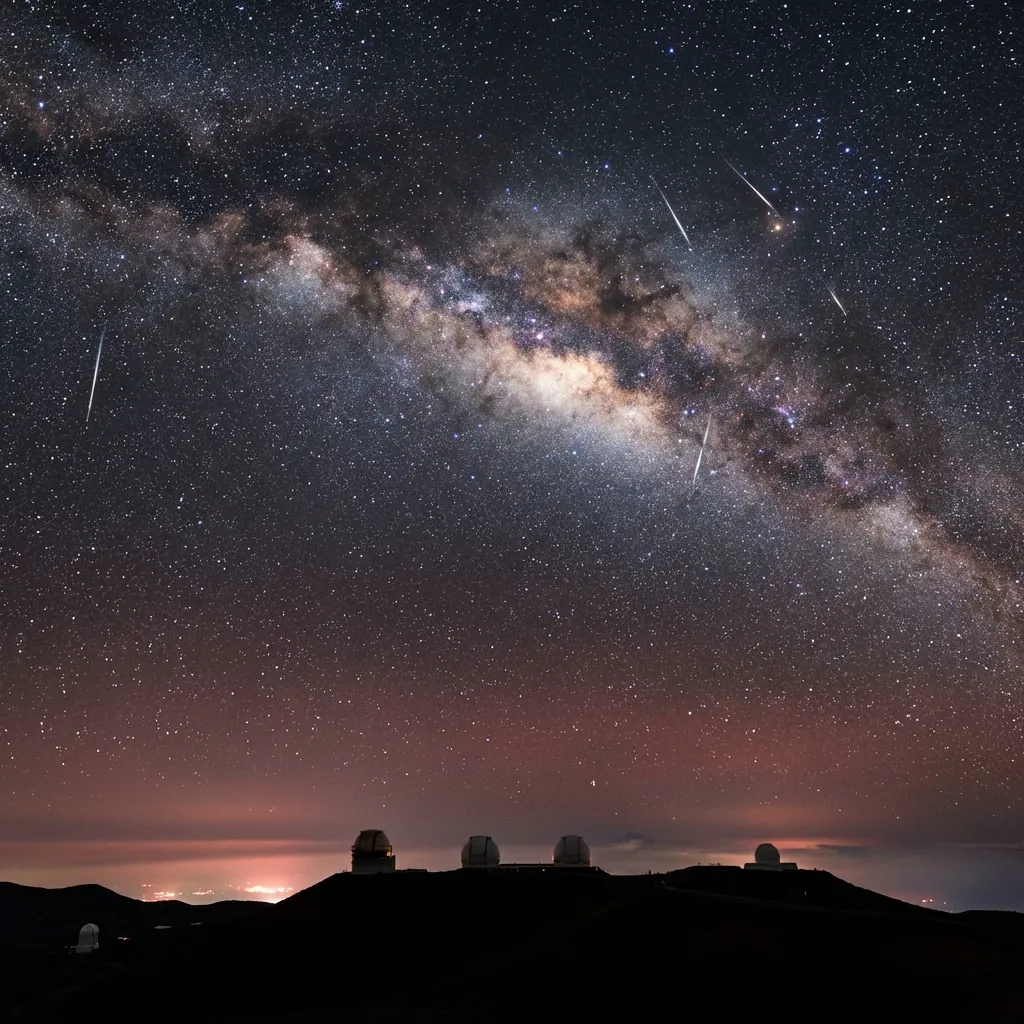
Witnessing a meteor shower from the 13,796-foot summit of Mauna Kea is a bucket-list experience for any astronomy enthusiast. With its pristine air and minimal light pollution, the “White Mountain” offers the best seat in the Pacific for the universe’s greatest light shows.
In 2026, several major meteor showers will coincide with favorable moon phases, providing exceptional dark-sky opportunities. This guide covers the key dates, what to expect, and how to maximize your chances of seeing “falling stars” over Hawaii.
Major 2026 Meteor Showers on Mauna Kea
The Quadrantids (January 3, 2026)
- Peak: Night of January 3
- Rate: 40-120 meteors per hour (brief peak)
- Moon: Full Moon (Poor conditions) While the Quadrantids can be spectacular, 2026 is a difficult year as the peak coincides with a bright Full Moon, washing out most activity.
The Lyrids (April 21–22, 2026)
- Peak: Pre-dawn hours of April 22 (Max activity ~9:40 AM HST)
- Rate: 15-20 meteors per hour
- Moon: Waxing Crescent (Good conditions after moonset) The Lyrids are known for fast meteors and occasional bright fireballs. Best viewed in the dark window between moonset (around 1:30 AM) and dawn on April 22nd.
The Eta Aquariids (May 5, 2026)
- Peak: Early morning May 5
- Rate: 30-60 meteors per hour
- Moon: Waning Gibbous (Fair conditions) This shower is created by debris from Halley’s Comet. While better from the Southern Hemisphere, Mauna Kea’s tropical latitude offers a decent view as the radiant rises in the small hours of the morning.
The Perseids (August 12–13, 2026)
- Peak: Night of August 12 into the morning of August 13
- Rate: 50-100 meteors per hour
- Moon: New Moon (EXCELLENT conditions) The Perseids are arguably the best meteor shower of the year. In 2026, the peak falls near a new moon, meaning the skies will be at their darkest. This is the prime time to book a Mauna Kea Observatory Tour to see the sky at its most active.
The Orionids (October 20–21, 2026)
- Peak: October 21 pre-dawn
- Rate: 15-25 meteors per hour
- Moon: Waxing Gibbous (Fair conditions) Created by debris from Halley’s Comet, these meteors are famous for being particularly fast and bright.
The Geminids (December 13–14, 2026)
- Peak: Night of December 14
- Rate: 120+ meteors per hour
- Moon: Waxing Crescent (Excellent conditions) The Geminids are the most reliable shower, often producing multi-colored streaks. In 2026, the moon sets early, providing a perfectly dark canvas for the year’s’ most intense display.
Bonus: 2026 Solar & Lunar Eclipses in Hawaii
Beyond meteors, 2026 brings two significant lunar events visible from the Hawaiian Islands:
- Total Lunar Eclipse (March 2–3, 2026): Hawaii will have a front-row seat as the moon passes through Earth’s shadow, turning a deep blood red. The entire eclipse will be visible from the Big Island.
- Partial Lunar Eclipse (August 27, 2026): A late-evening partial eclipse where a portion of the moon will be shaded by the Earth.
Understanding the Moon’s Role
The single biggest factor in meteor visibility (besides weather) is the Moon. A bright Full Moon washes out the fainter meteors, significantly reducing your “count” per hour.
Pro Tip: Look for peaks that occur during a New Moon or Crescent Moon phase. If the peak occurs during a bright moon phase, try to observe after moonset or before moonrise for the best results.
| Event | Date | Moon Phase | Visibility Rating |
|---|---|---|---|
| Quadrantids | Jan 3 | Full Moon | ★☆☆☆☆ |
| Lyrids | April 22 | Crescent | ★★★★☆ |
| Eta Aquariids | May 5 | Gibbous | ★★★☆☆ |
| Perseids | August 12 | New Moon | ★★★★★ |
| Orionids | October 21 | Gibbous | ★★★☆☆ |
| Geminids | December 14 | Crescent | ★★★★★ |
Expert Tips for Meteor Viewing in Hawaii
- Get High: The higher you are, the less atmosphere you’re looking through. Stargazing from 9,200 feet (Visitor Station) or higher is significantly better than sea level.
- Let Your Eyes Adjust: It takes about 20-30 minutes for your eyes to fully adapt to the dark. Avoid looking at your phone or using white flashlights.
- Look Toward the Radiant: While meteors can appear anywhere, they “originate” from a specific constellation (the radiant). For the Perseids, look toward Perseus; for Geminids, look toward Gemini.
- Dress Warm: Even in August, temperatures on Mauna Kea drop below 40°F at night. If you’re on one of our tours, we provide the parkas, but remember to wear layers!
Want the ultimate meteor shower experience? Our specialized tours include expert guides who can point out the radiants and set up professional telescopes for viewing deep-sky objects between meteor bursts. We provide the transportation, warm gear, and expert knowledge to make your night perfect.