Mauna Kea presents a stunning paradox. On an island synonymous with tropical warmth and lush greenery, it rises to an alpine realm of highland flora and copses of fir trees, offering vistas wholly unexpected in Hawaiʻi. This majestic mountain is a place of duality: a sacred landscape deeply woven into Native Hawaiian culture and, simultaneously, a global hub for astronomy, where humanity peers into the deepest corners of the cosmos. An adventure to its summit is a journey to the top of the Pacific—a place where earth and sky meet in a dramatic and profound way.
Planning Your Ascent: Essential Preparations
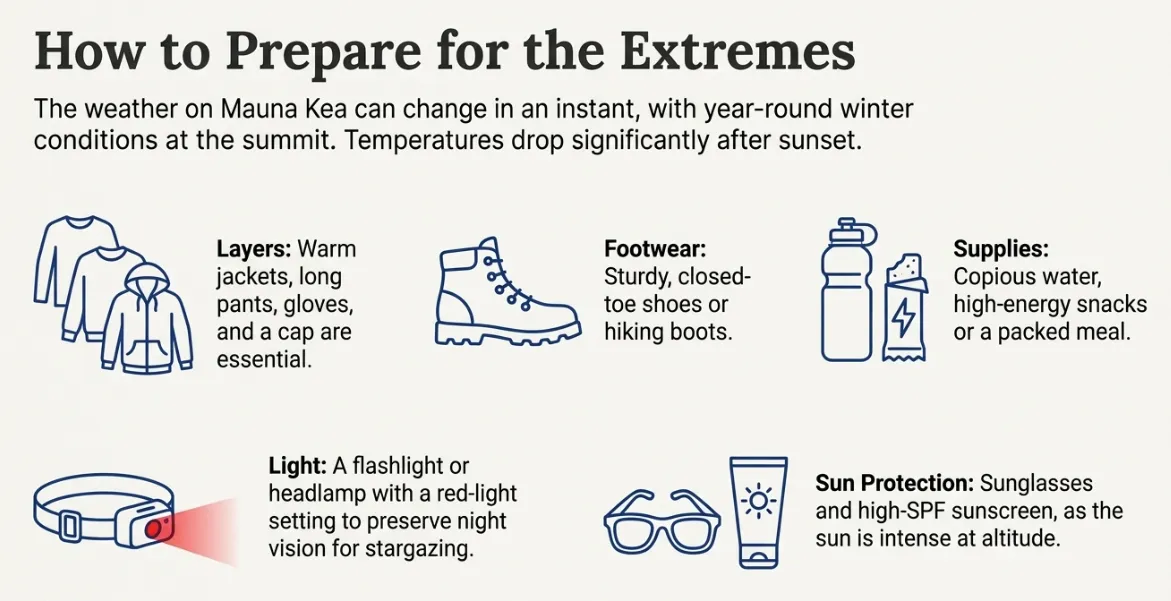
A trip to the summit of Mauna Kea is not a casual drive; it is an expedition into an extreme alpine environment that demands careful planning. The logistical challenges, unpredictable weather, and significant safety considerations make thorough preparation essential. This planning phase is the foundation for a journey that is not only safe and successful but also respectful of the mountain’s fragile ecosystem and cultural significance.
Vehicle Requirements: Your Key to the Summit
Your choice of vehicle is the single most critical factor for a safe ascent. A low-gear 4WD vehicle is the best and safest option for navigating the demanding summit road. Over half of this road consists of loose gravel, often at a steep 15% grade, creating conditions where standard vehicles can easily lose control.
Important: Most rental car company contracts explicitly prohibit driving their vehicles past the visitor center. According to expert sources, Harper Car & Truck Rentals is the only independent company mentioned that allows its 4WD vehicles to be driven to the summit of Mauna Kea. Be advised that Harper’s will require a high deductible, charge premium rates, and thoroughly inspect the vehicle condition upon return.
Essential Safety & Conditions
Visitors must be prepared for severe and rapidly changing conditions. Adhering to all safety guidelines is paramount.
Driving Hazards:
- The descent is as hazardous as the ascent
- You must drive in low gear to avoid overheating and brake failure
- Driving at sunrise or sunset can create blinding conditions
- Potential for sudden fog and ice adds significant risk
Physical Preparation:
- The summit requires winter mountaineering conditions preparation
- Be prepared for rapid temperature, precipitation, and air quality shifts
- Altitude sickness can affect visitors at 13,796 feet elevation
Nighttime Rules:
- Strict prohibition against using headlights on the summit after dark
- All vehicles must begin descent no later than 30 minutes after sunset
- This protects astronomical observations at the summit observatories
Choosing Your Approach: Guided Tours vs. Self-Drive
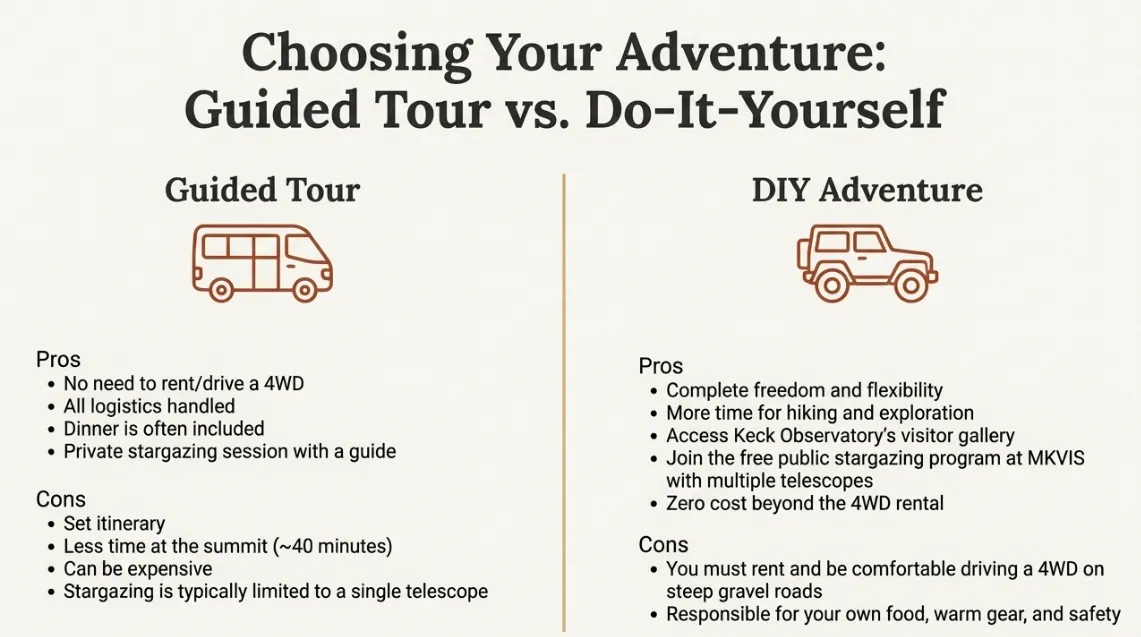
There are two primary ways to experience the summit: joining an organized tour or undertaking a self-guided drive.
Guided Tour Option: Several professional operators offer comprehensive summit tours. Our Mauna Kea Observatory Tour is one of the most popular options, featuring:
- Transportation to summit in specialized 4WD vehicles
- Expert guides with astronomy and cultural knowledge
- Warm parkas and gloves provided
- Dinner included
- Professional telescopes for stargazing
- Complete handling of all logistics and safety requirements
Self-Drive Option:
- Requires renting a suitable 4WD vehicle from specialized companies like Harper’s
- You are personally responsible for navigating the challenging road
- Must prepare for all potential hazards independently
- Higher risk but greater flexibility and adventure
Prefer a hassle-free experience? Book a guided summit tour with transportation, warm gear, professional telescopes, and expert astronomers included.
The Journey: Ascending to the Top of the Pacific
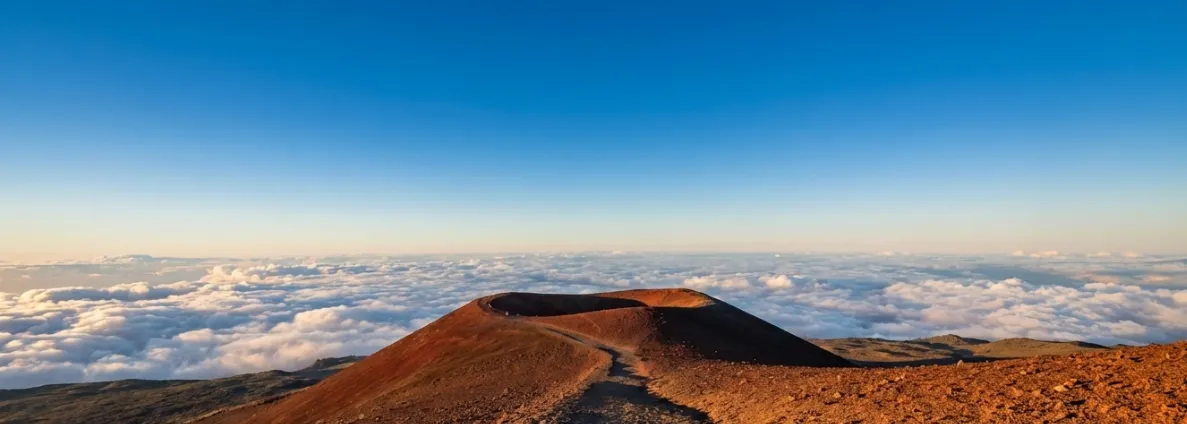
The drive to Mauna Kea is a transition through worlds. Leaving the coast behind, you first traverse the unique mid-elevation landscape of Saddle Road before beginning the final climb. The Summit Road then guides you through a barren, alpine environment that feels more like a distant planet than a tropical island, building anticipation for the breathtaking views that await at the top.
The Summit Road Driving Tour
Your true adventure begins at the Visitor Center, perched at a breathtaking 9,200 feet. From here, the 15-mile drive to the summit is a 1.5-hour journey that demands respect and focus.
Mile 0-5 (Paved Section): For the first five miles, you’ll navigate a paved road that winds upward through the sparse, otherworldly landscape. The air thins, the temperature drops, and the world below seems to fall away.
Mile 5-9 (Gravel Challenge): At the five-mile mark, the pavement ends abruptly. Now, the real test begins: four miles of steep, loose gravel where a 4WD vehicle in low gear is not just a recommendation, but a necessity. The vehicle will grip and slide as you ascend the punishing 15% grade. This is the heart of the challenge, a slow, deliberate climb where the raw power of the mountain is felt through the wheel.
Mile 9-15 (Final Summit Approach): Just as the gravel becomes relentless, at mile nine, the road miraculously returns to pavement. The final six miles are a smooth, surreal climb toward the heavens. The landscape is pure alpine desert, a canvas of red volcanic cinder cones under a dome of impossibly deep blue sky.
Landmarks at the Summit
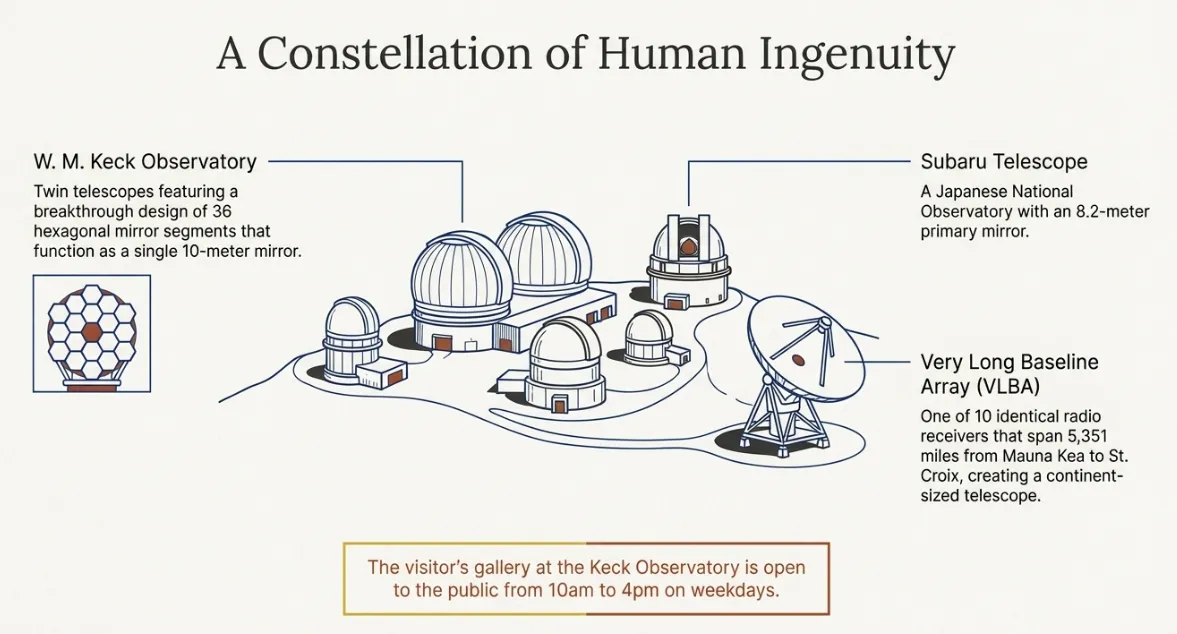
The summit area is a striking collection of natural volcanic cones and cutting-edge astronomical observatories. Among the most impressive man-made structures are the Keck Twins, a pair of the largest astronomical telescopes in the world.
The natural landscape is dominated by prominent peaks:
- Pu’u Wekiu (13,796ft) - The highest point in the Pacific
- Pu’u Hauoki (13,660ft)
- Pu’u Poli’ahu (13,631ft)
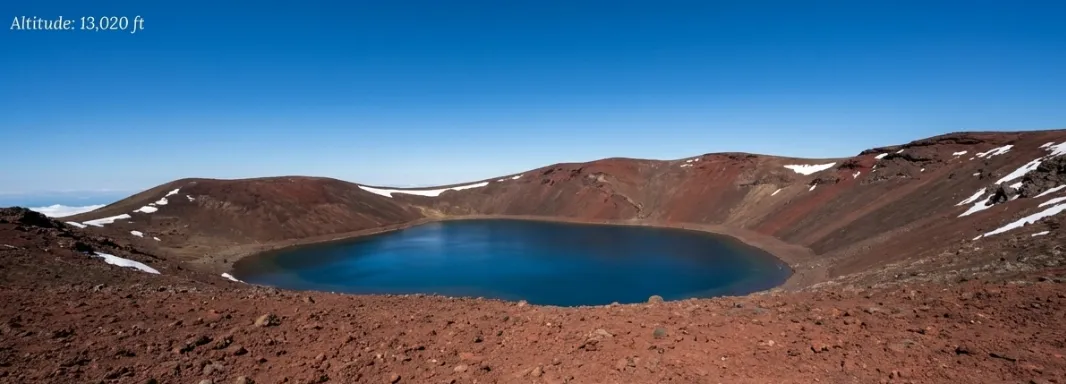
Tucked among these peaks is a surprising high-altitude feature: Lake Waiʻau, a small but significant body of water in this arid, alpine desert. This sacred lake holds deep cultural importance for Native Hawaiians.
As the sun begins to set, the focus shifts from the terrestrial landscape to the celestial spectacle that makes this mountain a global icon.
Under the Stars: Mauna Kea’s Celestial Spectacle
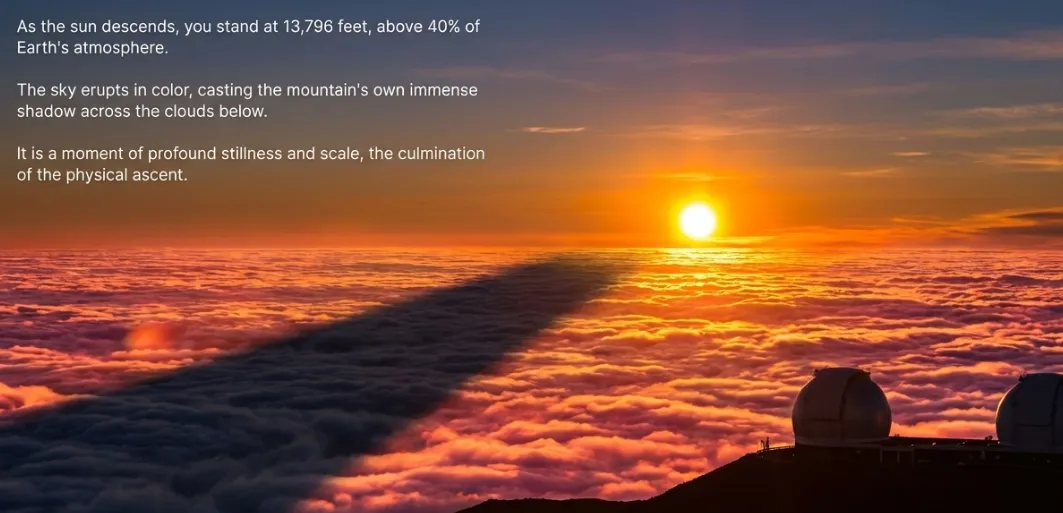
Mauna Kea’s high altitude, clear air, and isolation from light pollution make it one of the world’s premier locations for astronomical observation, which is why the world’s most advanced observatories are perched on its summit. For many visitors, the opportunity to witness the cosmos from this vantage point is the culminating experience of their journey, offering a view of the night sky with unparalleled clarity and brilliance.
Guided Stargazing Programs
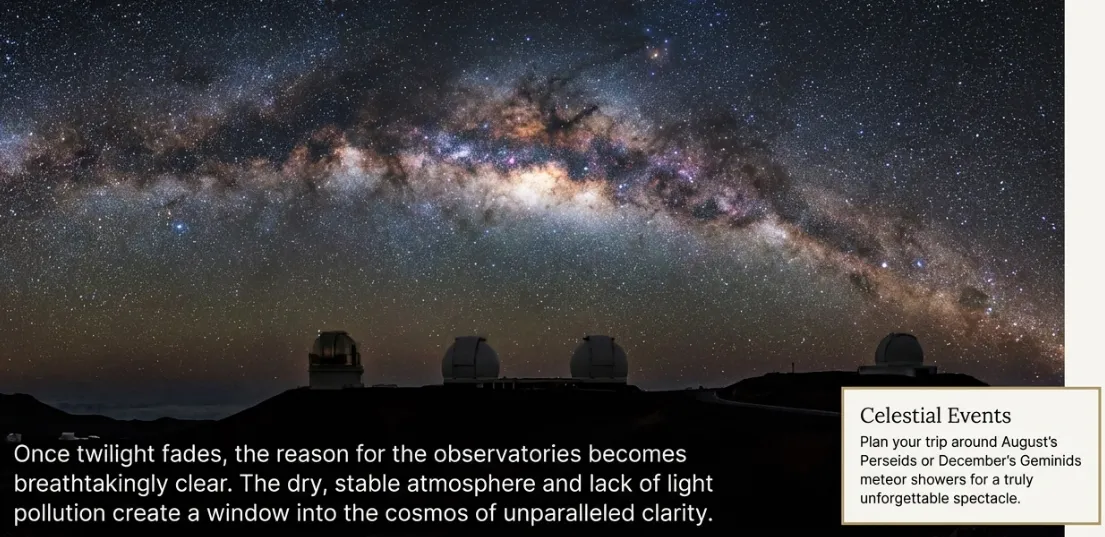
The Mauna Kea Volunteer Program offers public stargazing sessions that bring the cosmos to life. These programs are led by dedicated volunteers who are part of a larger stewardship effort; in addition to sharing their astronomical knowledge, these volunteers also clean up trash and staff the visitor center. Their passion provides a unique, community-led opportunity to explore the universe through telescopes from this world-renowned location.
Professional stargazing option: Our guided tours feature expert astronomers with professional-grade telescopes, providing deeper insights into the cosmos and personalized instruction on navigating the night sky.
Stargazing Etiquette and Rules
Respecting the scientific work conducted on the mountain is essential:
- Headlights from vehicles critically interfere with sensitive astronomical observations
- All visitors must adhere to the strict requirement to be off the summit and descending 30 minutes after sunset
- Use red-filtered flashlights only if absolutely necessary
- Minimize noise and light pollution
While Mauna Kea is a beacon for science and recreation, it is first and foremost a place of deep cultural and spiritual importance.
Mauna Kea’s Sacred Heart: Culture and Controversy
To truly understand Mauna Kea is to look beyond its physical stature and scientific achievements and appreciate its profound spiritual importance to Native Hawaiians. The mountain is not merely a geographic feature but a sacred entity, a place of reverence and ancestral connection. This cultural landscape provides essential context for any visitor seeking a complete and respectful experience.
A Sacred Mountain
For many Native Hawaiians, the mountain is sacred, a belief that is central to their identity and heritage. This deeply held conviction has been powerfully expressed through peaceful protests against further development on the summit, most notably in opposition to the planned Thirty Meter Telescope (TMT).
The Thirty Meter Telescope (TMT) Conflict
The controversy surrounding the TMT highlights the complex intersection of science, culture, and history on Mauna Kea:
Development Perspective:
- In 2014, a groundbreaking ceremony for the $1.4 billion telescope was halted by peaceful protesters
- Extensive efforts included dozens of community meetings
- Site selected away from known burials and endangered plants
- $1 million annual commitment to science education in Hawaiʻi
Cultural Opposition:
- For opponents, concessions don’t address the core issue
- Development viewed as continuation of colonial disregard for sacred land
- Protesters called for University of Hawaiʻi’s lease to be turned over to community-based authority
- Request for representation of all interests, not just scientific ones
Understanding this context is vital for appreciating your role as a visitor on this venerated mountain.
Visiting with Aloha: Your Role as a Responsible Visitor
Given Mauna Kea’s profound cultural and environmental sensitivity, visiting with respect, awareness, and aloha is not just encouraged—it is essential. As a visitor, you have the opportunity to be a mindful and positive presence, honoring the mountain’s significance and helping to preserve its unique character for generations to come.
Principles of Respectful Visitation
By following these key principles, you can ensure your visit is a responsible one:
Respect Sacredness:
- Acknowledge that you are in a place of deep cultural importance
- Keep away from any areas that resemble sacred sites or ancient Hawaiian structures (heiau)
- Approach the mountain with reverence and humility
Observe Kapu:
- Heed all posted kapu (no trespassing) signs
- These mark areas that are off-limits for cultural, spiritual, or environmental reasons
- Violations can result in fines and disrespect sacred Hawaiian traditions
Adhere to Rules:
- Strictly follow all posted regulations
- Follow driving safety protocols
- Observe the nighttime curfew requiring descent 30 minutes after sunset
- Stay within designated areas only
Minimize Your Impact:
- The alpine ecosystem is incredibly fragile
- Stay on marked trails and roads to protect the environment
- Pack out all trash
- Don’t disturb rocks, plants, or archaeological features
- Leave no trace of your visit
Giving Back: The Mauna Kea Volunteer Program
For those wishing to make a more direct contribution, the Mauna Kea Volunteer Program offers a meaningful way to give back. Volunteers engage in crucial stewardship activities:
- Cleaning up trash to maintain the pristine environment
- Leading star-gazing programs to share the wonders of the night sky
- Staffing the visitor center to assist and educate fellow visitors
Participating in this program provides a tangible way to connect with the mountain and actively contribute to its care.
Ready for Your Summit Adventure?
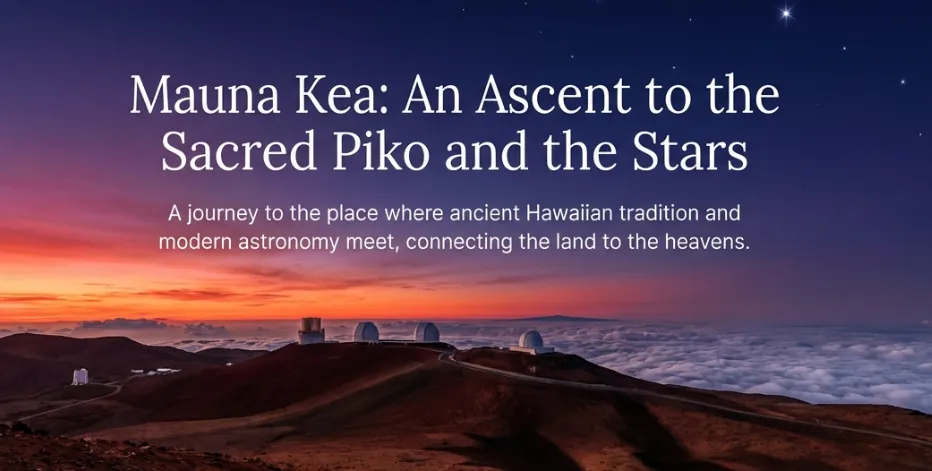
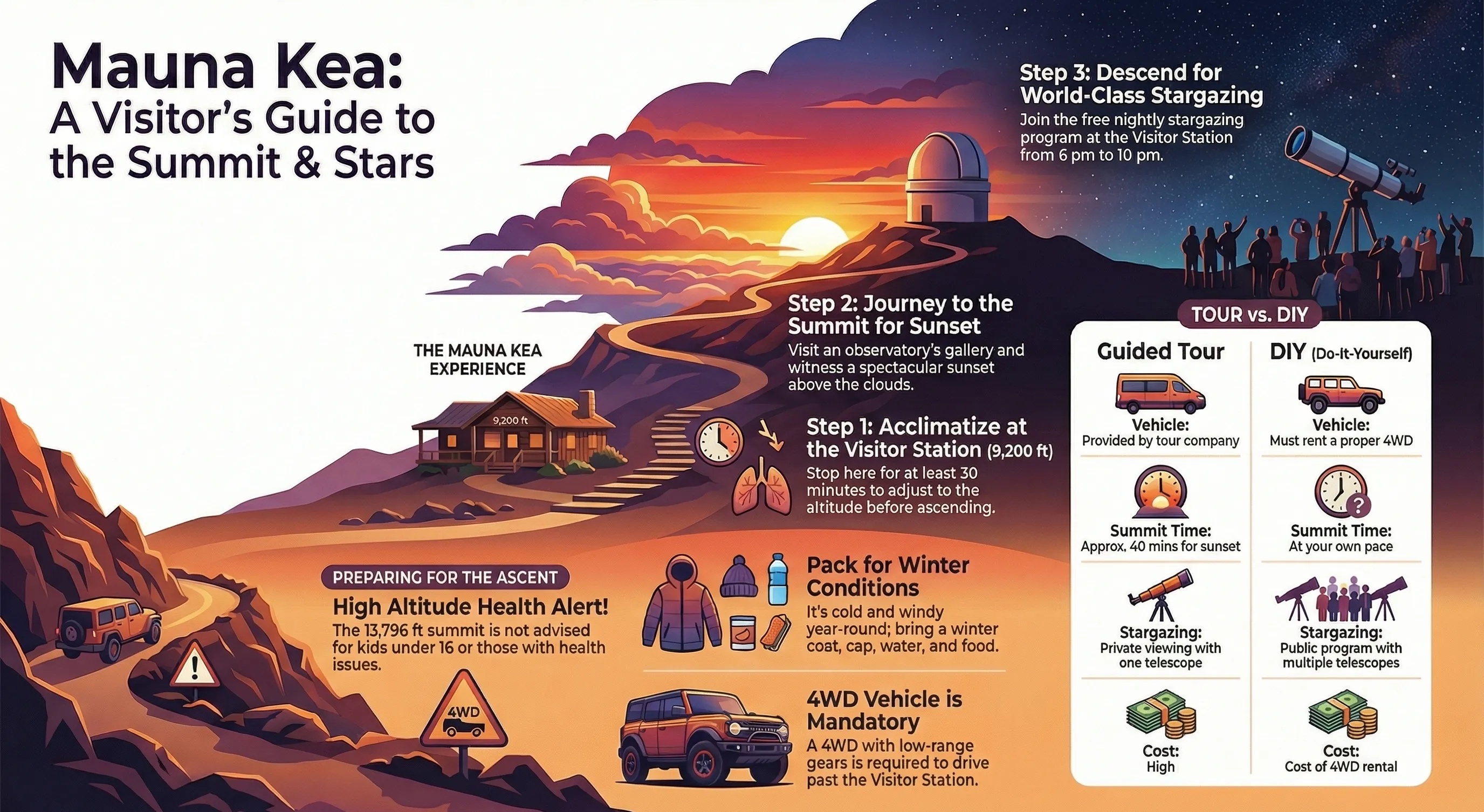
A Mauna Kea summit and stars adventure is an unforgettable journey combining stunning alpine landscapes, world-class astronomy, and profound cultural significance. Whether you choose a professionally guided tour or a self-drive adventure, this experience offers a unique perspective on Hawaii’s highest peak.
Not sure which operator to choose? Our full comparison of Mauna Kea stargazing tours breaks down every guided option — prices, ratings, what’s included, and a plain-English recommendation for each type of traveler.