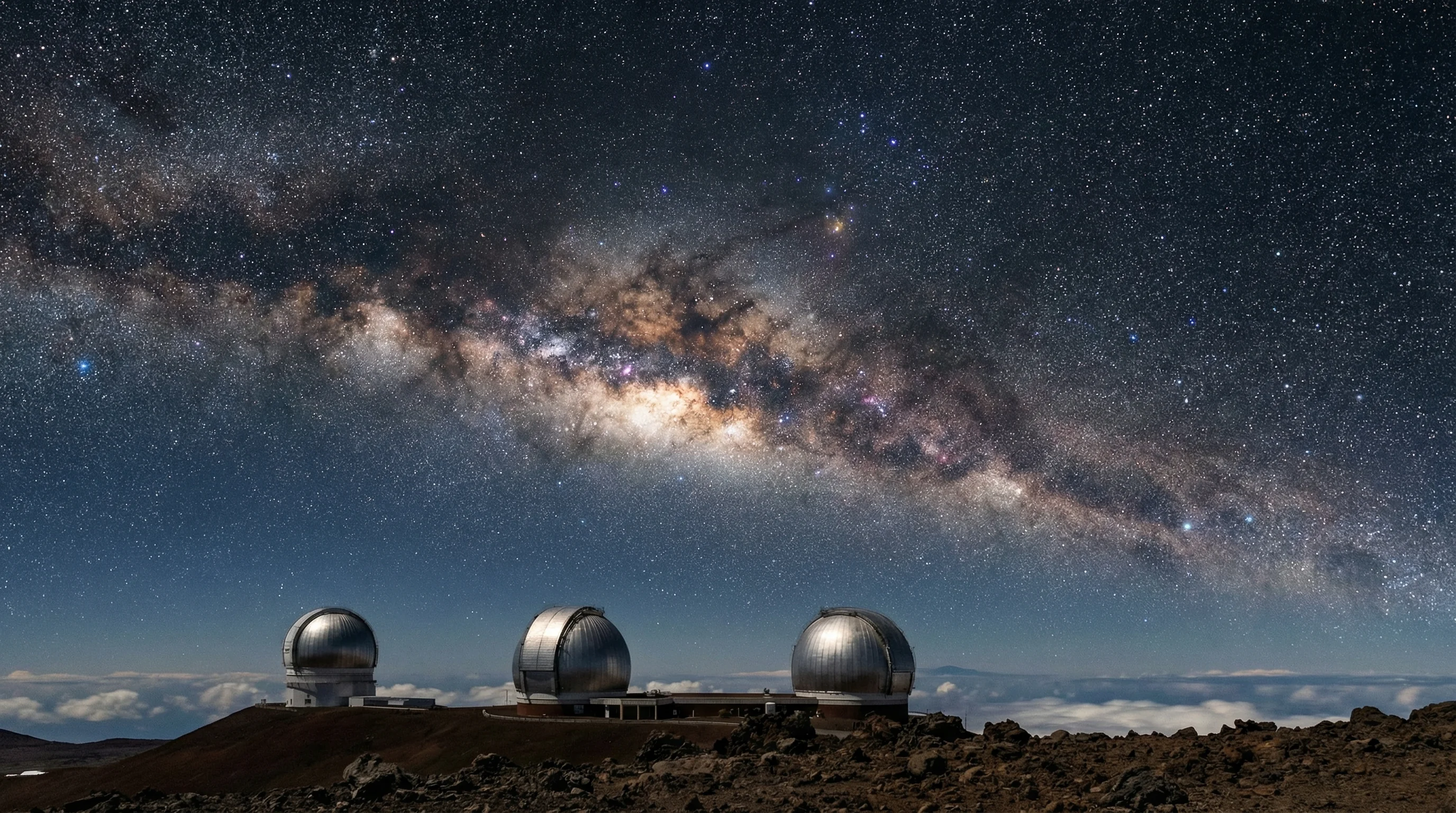
The short answer
Any month works on Mauna Kea; the moon decides more than the calendar does. The summit sits above most of the island’s weather. Over three years of nightly readings, the Canada-France-Hawaii Telescope’s sky monitor found skies clear enough to observe on 76% of nights, and only a modest seasonal swing, about 4%, in how often they were cloud-free. Pick an evening between the last-quarter moon and about three days after new moon, and you will be under a moonless sky for the whole of an evening tour.
What the month does change is how cold it gets, when full darkness arrives and what is overhead:
- Milky Way photographers: come in summer and pick the new-moon week. The bright core of the Milky Way sits low in the southern sky in the evening around Scorpius and Sagittarius, and a new moon is what lets it show.
- First-timers: any month, a night in the dark-evening window below, on a summit sunset tour. You watch the sun go down from the top, then the group drops lower for the stars, because the summit closes to visitors 30 minutes after sunset.
- Families with children under 13: the University of Hawaiʻi discourages anyone under 13 from going above the Visitor Information Station at 9,200 ft, and summit tours turn them away. Plan an evening at the VIS level instead (details below).
- Winter visitors (December to March): the sky is about as clear on average as in summer and full darkness comes up to 90 minutes earlier than in July, but the nights are the coldest of the year and storms can shut the summit road. Keep a second night spare.
The summit sunset tour, with its calendar. Pick a date inside one of the dark-evening windows in the next section:
The moon rule, and the dark evenings to November 2027
NASA’s moon-phase guide gives the timing that matters. A full moon rises at sunset and stays up all night, which washes out the Milky Way. A first-quarter moon is high in the evening and sets around the middle of the night. The two kinds of evening that stay dark are the ones after the last quarter (that moon rises around the middle of the night) and the first few after the new moon, when a thin crescent sets soon after the sun.
Mauna Kea tours run in the evening and the Visitor Information Station closes at 9 pm, so the useful stretch is from last quarter to about three days after new moon. Dates below are from the US Naval Observatory’s phase tables, converted to Hawaiʻi time (UT minus 10 hours).
| Dark evenings (HST) | New moon (HST) |
|---|---|
| Nov 1 to Nov 11, 2026 | Nov 8, 2026, 9:02 pm |
| Nov 30 to Dec 11, 2026 | Dec 8, 2026, 2:52 pm |
| Dec 30, 2026 to Jan 10, 2027 | Jan 7, 2027, 10:24 am |
| Jan 29 to Feb 9, 2027 | Feb 6, 2027, 5:56 am |
| Feb 27 to Mar 10, 2027 | Mar 7, 2027, 11:29 pm |
| Mar 29 to Apr 9, 2027 | Apr 6, 2027, 1:51 pm |
| Apr 28 to May 9, 2027 | May 6, 2027, 12:58 am |
| May 28 to Jun 7, 2027 | Jun 4, 2027, 9:40 am |
| Jun 26 to Jul 6, 2027 | Jul 3, 2027, 5:02 pm |
| Jul 26 to Aug 5, 2027 | Aug 2, 2027, 12:05 am |
| Aug 24 to Sep 3, 2027 | Aug 31, 2027, 7:41 am |
| Sep 23 to Oct 2, 2027 | Sep 29, 2027, 4:36 pm |
| Oct 22 to Nov 1, 2027 | Oct 29, 2027, 3:36 am |
The nights to avoid if stars are the point are the ones around full moon: Nov 24 and Dec 23, 2026; Jan 22, Feb 20, Mar 22, Apr 20, May 20, Jun 18, Jul 18, Aug 16, Sep 15 and Oct 15, 2027 (HST). The sunset from the summit is the same with or without a moon, so a full-moon date still works if the sunset is what you came for.
Month by month: how cold, when the sun sets, when it is fully dark
The cloud odds barely move through the year, so this table leaves them out on purpose: we found no issuer that publishes clear-night odds for each month, and a column of guesses would be worse than none. What does change is in the table.
| Month | Summit average low | Lowest, 1994–2006 | Sunset (1st) | Fully dark (1st) |
|---|---|---|---|---|
| January | 27°F (−2.7°C) | 12°F (−10.9°C) | 5:54 pm | 7:13 pm |
| February | 26°F (−3.5°C) | 14°F (−10.1°C) | 6:14 pm | 7:30 pm |
| March | 26°F (−3.2°C) | 14°F (−9.8°C) | 6:27 pm | 7:40 pm |
| April | 29°F (−1.4°C) | 19°F (−7.3°C) | 6:36 pm | 7:50 pm |
| May | 31°F (−0.5°C) | 22°F (−5.7°C) | 6:45 pm | 8:03 pm |
| June | 34°F (1.1°C) | 22°F (−5.3°C) | 6:57 pm | 8:20 pm |
| July | 33°F (0.7°C) | 23°F (−4.9°C) | 7:05 pm | 8:28 pm |
| August | 34°F (1.1°C) | 23°F (−4.9°C) | 6:58 pm | 8:18 pm |
| September | 35°F (1.6°C) | 27°F (−2.9°C) | 6:37 pm | 7:51 pm |
| October | 33°F (0.4°C) | 22°F (−5.4°C) | 6:10 pm | 7:23 pm |
| November | 31°F (−0.7°C) | 19°F (−7.2°C) | 5:47 pm | 7:02 pm |
| December | 29°F (−1.4°C) | 14°F (−10.2°C) | 5:42 pm | 6:59 pm |
Temperatures: monthly mean daily minimum and lowest reading at the summit weather station of the Canada-France-Hawaii Telescope, 1994 to 2006, from the Maunakea Weather Center’s climatology study. Sunset and the end of astronomical twilight (“fully dark”): US Naval Observatory tables for the Visitor Information Station’s position, Hawaiʻi time, 2027; each year differs by a minute or two.
Three things fall out of it:
- Every month, you are off the summit before it is fully dark. The summit closes to visitors 30 minutes after sunset, and full darkness comes 73 to 83 minutes after sunset all year. The stargazing always happens lower down, on every tour and every DIY trip.
- Winter saves you an hour and a half of waiting. Full darkness on December 1 is at 6:59 pm; on July 1 it is at 8:28 pm. For children, or for anyone with an early start next day, that matters more than the temperature.
- February and March are the coldest nights, not December. The summit averages just below freezing at night in every month from November to May, and the record lows in winter sit around 12 to 14°F. The air is also bone dry: relative humidity at the summit averages 36% and bottoms out in April at 30%.
The month also changes the odds that your night happens at all. Mauna Kea Summit Adventures, a summit tour operator, cancels about one tour in ten for weather or road closures, and names August, September, January, February and March as its least stable months. That is why April-to-October “dry season” advice does not hold up: two of the operator’s five worst months sit inside it.
What you can see, season by season
- Summer evenings (roughly June to August): the bright, dense part of the Milky Way, which marks the direction of the galaxy’s centre, lies low in the south near Scorpius and Sagittarius late in the evening. Because the islands sit near 20° north, it climbs higher here than from most of the mainland.
- Late spring: this is the evening season for the Southern Cross, Hanaiakamalama, which NASA’s astronomy picture service notes is unfamiliar to skywatchers north of about 25° latitude. The Polynesian Voyaging Society, which navigates Hōkūleʻa by these stars, timed it standing upright over the south at 8:35 pm off South Point on May 30. From Hawaiʻi, the bottom star sits about 6° above the horizon, so you need a clear view to the south.
- Late October and November: Makaliʻi, the Pleiades, rises at sunset. The National Park Service notes that this rising, around late October or early November, opens Makahiki, the four-month Hawaiian new-year season.
Visitor Information Station vs the summit, and what changed at the VIS
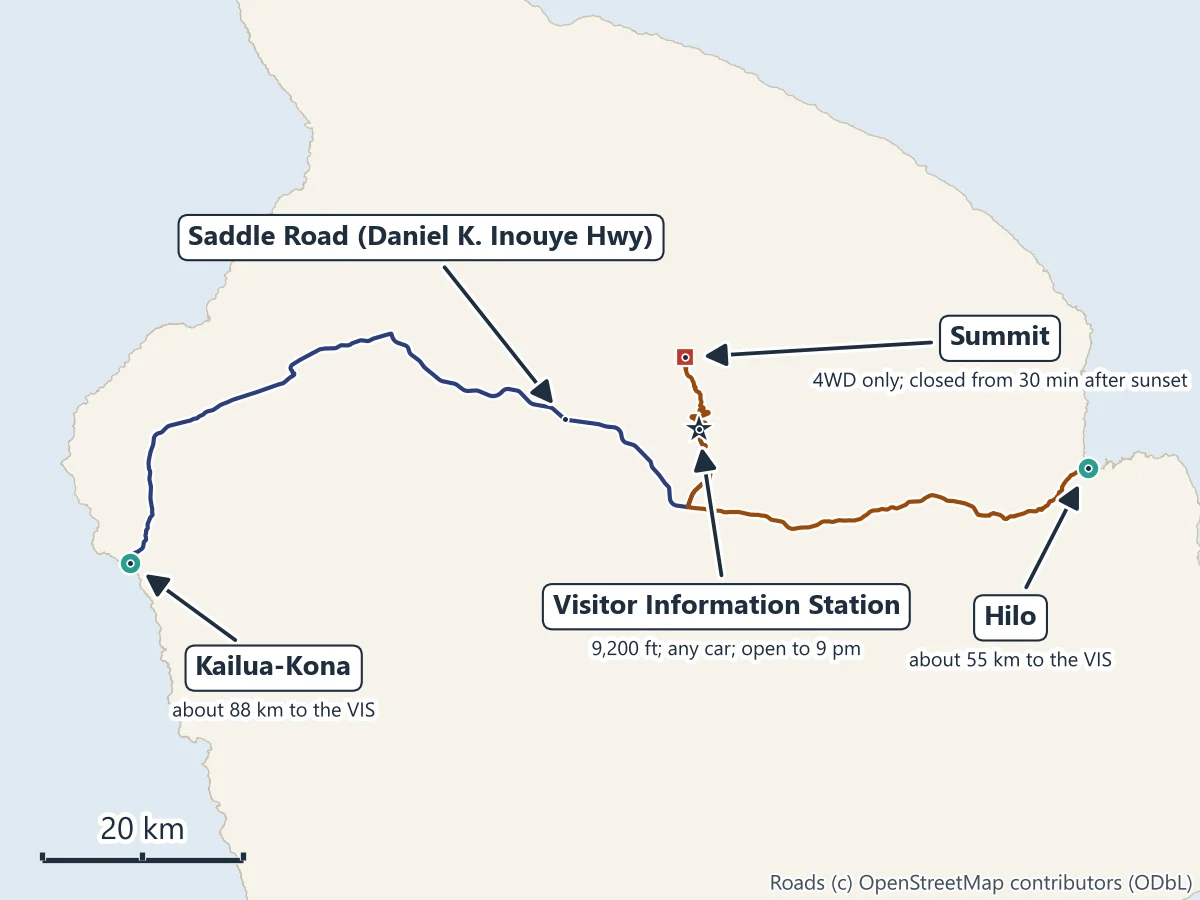
The Visitor Information Station sits at 9,200 ft on the Mauna Kea Access Road, which leaves Saddle Road (the Daniel K. Inouye Highway) at milepost 28. On the roads drawn on the map, it is about 55 km (34 miles) from downtown Hilo and about 88 km (55 miles) from Kailua-Kona.
At the VIS (checked October 2026):
- Open from 9 am to 9 pm, every day of the year, with no registration, entrance or parking fee. Any car can reach it on the paved road.
- There is no nightly telescope programme. The University of Hawaiʻi at Hilo, which runs the station, says the nightly telescope programme was halted in 2019 over safety concerns and overcrowding, and that the VIS has no public-use telescopes. Older guides, including earlier versions of this site’s pages, describe free telescope nights; those ended in 2019.
- You can still come on any night and look up. After twilight, staff sometimes give a short laser-pointer talk about the sky, depending on weather and staffing. Most evening visitors watch the sunset from Puʻukalepeamoa, known as Sunset Hill, and stay for the stars.
- Telescopes come out once a month at the Telescope Experience, a free, reservation-only evening at a viewing site near the VIS: check-in 5:15 pm, finishing around 8:30 to 9 pm. One reservation covers up to two adults and three children, a party can book once per quarter, and dates go up two to three months ahead. The November 2026 public event was already full when we checked. Children of all ages may attend, although the organisers warn that children 5 and under often struggle with the telescopes.
- Bring your own warm layers, food and water: the station sells small snacks when available and only water to drink, and open flames are not allowed.
On the summit:
- 4WD or AWD only. The University of Hawaiʻi does not permit 2WD vehicles above the VIS. The summit road is eight miles long, climbs nearly 5,000 ft, and its unpaved sections are only one lane wide.
- Closed to visitors from 30 minutes after sunset to 30 minutes before sunrise. If you stay on the mountain to stargaze, you must come down to Park 2.
- Stop at the VIS for at least 30 minutes on the way up to acclimatise.
So the honest split is this. The VIS is free, open to everyone and very dark, but on almost every night of the month you bring your own eyes and binoculars. If you want to look through a telescope on a night you choose, it has to come with a tour.
See the tour that brings a telescope →
Who cannot go to the summit
The University of Hawaiʻi tells these visitors not to go above the Visitor Information Station: children under 13, pregnant people, anyone who has been scuba diving in the previous 24 hours, anyone intoxicated, and people with high blood pressure or a heart or respiratory condition. The summit has about 40% less oxygen and air pressure than sea level.
Tour operators apply the same core rules and add their own, as listed on their GetYourGuide pages in October 2026:
| Tour | Not for |
|---|---|
| Mauna Kea Summit, Sunset & Stargazing (Hawaii Island Holidays) | under 13, over 80, pregnancy, heart or breathing problems, back problems, diving within 24 hours |
| Summit Sunset & Star Tour with Photo (Hawaiian Eyes Tours) | under 16, over 75, over 300 lb (136 kg), pregnancy, breathing problems, recent surgery, diving within 24 hours |
| Hilo: Mauna Kea Summit Tour (Arnott's Lodge) | under 13, pregnancy, heart problems, high blood pressure, breathing problems, diving within 24 hours |
| Mauna Kea Hike & Star Gazing with Native Hawaiian (stays below the summit) | under 9, pregnancy, heart problems, limited mobility |
Mauna Kea Summit Adventures also turns away guests with a body mass index of 40 or more, and another summit operator takes guests over 80 only on private tours. If your group includes a child under 13 or anyone the summit rules out, stay at the VIS level: the hike above goes to about 9,500 ft, and the station itself is open until 9 pm.
What to wear
Dress for winter, whatever the month. The table shows summit nights at or below freezing from November to May and only a few degrees above it in summer, and the University of Hawaiʻi warns that winter conditions, with freezing temperatures and strong winds, can arrive at any time of year.
- Layers you can add and remove: a sweater or fleece over a warm layer, long trousers and closed-toe shoes. On its summit, stargazing and dinner tour, Hawaii Forest & Trail asks guests for long pants, closed-toe shoes and a sweatshirt or sweater, and supplies parkas and gloves.
- The heavy layer usually comes with the tour. The two summit tours in the cards below supply parkas and gloves, and the Hawaiian Eyes Tours photo tour adds ski pants. On a DIY trip, bring your own winter jacket, hat and gloves.
- Water and sun protection. The air is so dry that the University of Hawaiʻi suggests about 500 ml (17 fl oz) of water per person per hour, plus sunscreen and sunglasses for the sunset hours.
Pick your night, then the tour
Prices, ratings and inclusions below are from the tours’ GetYourGuide listings, read in October 2026.
Book whichever fits your group:
Summit sunset, then stars
Sunset from the top, then stargazing lower down, with parkas, gloves, snacks, hot chocolate and night photos sent by email.
Check dates →Summit tour with photos
A DSLR photo of the sunset and the stars, an astronomical telescope, and ski pants as well as a parka.
See the photo tour →Below the summit, with a Native Hawaiian guide
A guided hike to about 9,500 ft with Hawaiian history and legends, sunset and stargazing; it meets just below the Visitor Information Station.
See the hike →Prices, ratings and review counts from our October 2026 data check; operators use seasonal pricing — treat them as the shape of the market, not a quote.
All three listings offer free cancellation, which is the cheap insurance against a stormy night: book early inside a dark-evening window, and if the forecast turns, cancel and rebook another night in the same window. For every other operator, with prices and what each includes, see our comparison of Mauna Kea stargazing tours.
More Mauna Kea tours
Questions people ask
What is the best time to visit Mauna Kea for stars? Any month, on an evening between the last-quarter moon and about three days after new moon. The summit is clear enough to observe on roughly three nights in four, and that barely changes with the season. Arrive at the Visitor Information Station 1.5 to 2 hours before sunset if you plan to drive to the summit for the sunset itself.
Can I go to Mauna Kea at night? Yes, up to the Visitor Information Station at 9,200 ft, which is open until 9 pm and needs no 4WD. The summit area closes to visitors from 30 minutes after sunset to 30 minutes before sunrise, so after dark you stargaze lower down.
Is there free stargazing at the Mauna Kea Visitor Center? The station is free to visit and you can stargaze there on your own, but the nightly telescope programme was halted in 2019 and the VIS has no public telescopes. Telescopes come out once a month at a free Telescope Experience that needs a reservation and fills weeks ahead.
Where is the best place to stargaze on Mauna Kea? For most visitors, around the Visitor Information Station at 9,200 ft: everyone can reach it and it stays open until 9 pm. The summit is only for sunset, because it closes 30 minutes later.
Can you see the Milky Way from Mauna Kea? Yes, on any clear night without a bright moon. Its brightest part, toward the galaxy’s centre, sits in the southern sky near Scorpius and Sagittarius on summer evenings.
How cold is Mauna Kea at night? At the summit, the average night low runs from about 26°F (−3.5°C) in February to about 35°F (1.6°C) in September, and winter nights have dropped to around 12°F (−11°C). Tours lend parkas and gloves; on your own, bring winter clothes.
Sources, read October 2026: University of Hawaiʻi at Hilo, Center for Maunakea Stewardship (Visitor Information Station, stargazing, Telescope Experience and safety pages); Maunakea Weather Center climatology study (da Silva, 2006); US Naval Observatory (moon phases, sunset and astronomical twilight tables); Steinbring, Cuillandre and Magnier, Mauna Kea sky transparency from CFHT SkyProbe data; NASA Astronomy Picture of the Day (Southern Cross in Mauna Loa skies); NASA Science (moon phases, July 2026 sky guide); Polynesian Voyaging Society; National Park Service, Haleakalā National Park (Makahiki); Mauna Kea Summit Adventures (FAQ); the tours’ own GetYourGuide listings.